# Hollow Knight Deep Dive — Why a Three-Person Indie Still Sets the Metroidvania Standard

Developer: Team Cherry | Price: $14.99 | Platforms: PC, Switch, PS4, Xbox
The Benchmark Nobody Expected
In 2017, a three-person studio called Team Cherry shipped a game out of Adelaide, Australia. The crowdfunding campaign raised $57,000. The asking price was $14.99. The content volume rivaled AAA releases.
Nearly a decade later, Hollow Knight holds hundreds of thousands of Steam reviews — overwhelmingly positive — and sits at the top of every metroidvania recommendation list worth reading. Metroid, Dark Souls, and scores of competing indie games have all come since. None have displaced it as the genre's reference point.
This isn't a nostalgia argument. The design holds up on first play today. Here's a full breakdown of what makes Hollow Knight work — and what new players should know before descending into Hallownest.
The World of Hallownest: Atmosphere Over Exposition
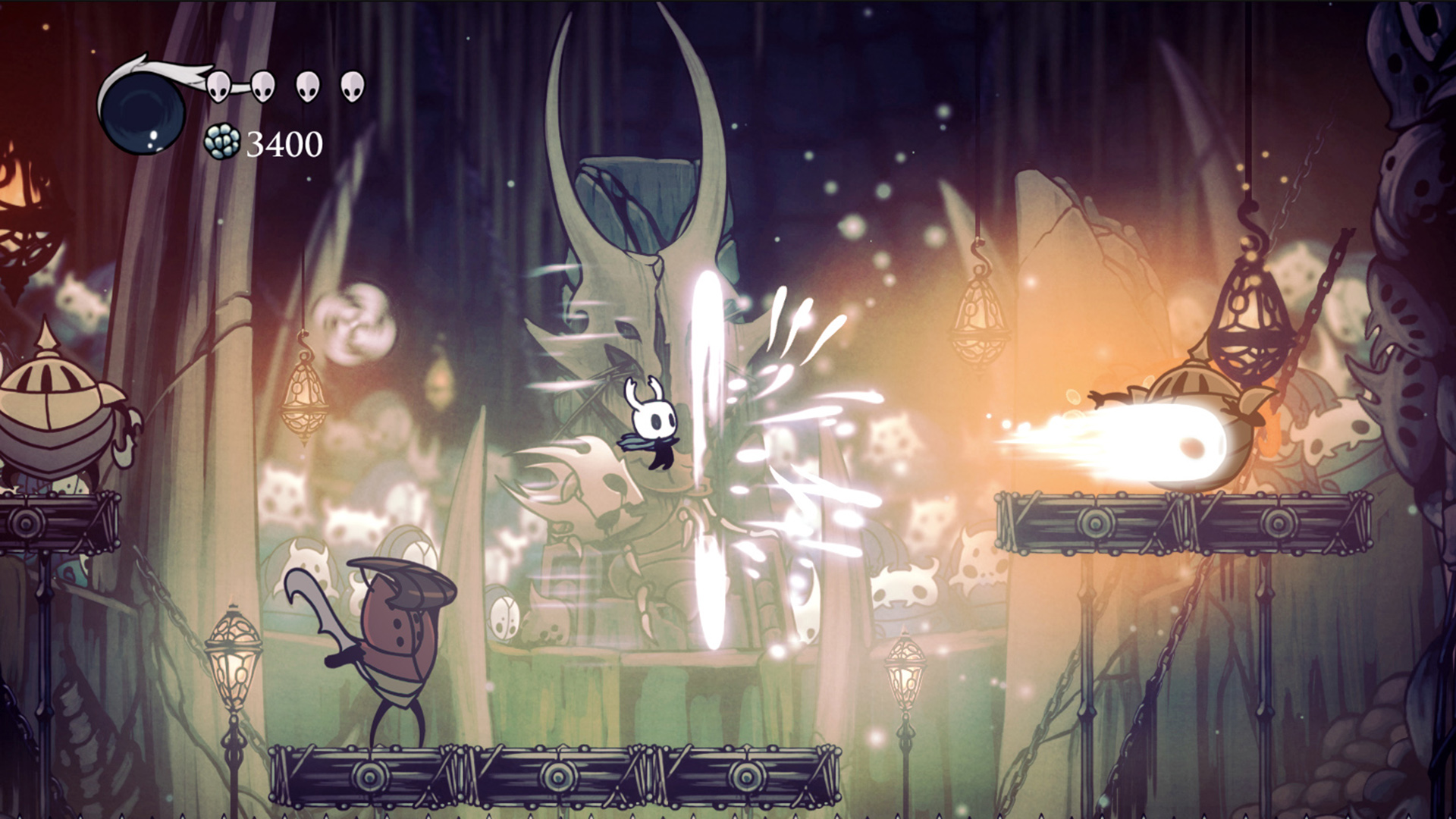
Hallownest is a dead kingdom beneath the surface — a civilization of insects that flourished, built, fought, and collapsed before the player arrives. You play as the Knight, a small, silent figure descending without stated purpose into its ruins.
What separates Hollow Knight's world-building from most games in the genre is its commitment to environmental storytelling over delivered exposition. NPCs speak in fragments. Item descriptions are sparse. The lore is present throughout — embedded in the architecture of ruined cities, the corpses of fallen warriors, the dim glow of fungal caverns — but the game trusts the player to assemble it.
This approach owes something to Dark Souls (item descriptions, cryptic dialogue, a world shaped by events long over), but Hollow Knight leans harder on visual language. Christopher Larkin's orchestral score shifts register entirely between areas. Each region — from the peaceful Forgotten Crossroads to the rain-soaked City of Tears to the suffocating darkness of Deepnest — has a distinct chromatic identity and a distinct emotional tone.
The effect accumulates. By the time a player reaches the City of Tears and hears rain for the first time, falling through a cavern they had no map for, the game has already built something most AAA titles spend entire cutscenes trying to establish.
Core Mechanics: Dream Nail, Charms, Nail Arts, and Soul
Hollow Knight's combat reads as simple on first contact: swing your nail, dodge, and cast spells. The depth emerges from how the systems interlock.
The Soul Meter is the mechanical heart of combat. Hitting enemies generates Soul, which is spent either to heal or to cast spells. This shared economy forces decisions on every encounter: spend Soul conservatively to top off health, or burn it aggressively on Vengeful Spirit fireballs to end the fight faster. The choice is never abstract — it's made in real time, under pressure.
The Charm system is how Hollow Knight handles build identity. Charms are equippable items scattered throughout Hallownest, each providing a specific modifier: faster nail swing speed, a health boost, a healing aura, additional spell damage, a friendly floating companion. They're equipped via Notch slots, and you have a limited number of slots at any time. The result is that two players with 40 hours each can be running entirely different characters — one built around aggressive quick-clearing, another around safe poke-and-heal rhythms.
Nail Arts — learned from Nail Masters found in the world — add offensive variety. A charged slash, a dash-attack, a spinning strike. Each has situational value in boss fights, and knowing when to use each rather than spamming the basic attack is the skill gap between early- and late-game play.
The Dream Nail is the system that opens the game's second layer. Acquired mid-game, it lets the Knight access the dreams of sleeping enemies, NPCs, and certain objects — revealing hidden dialogue, memories, and history that the surface of the world doesn't tell you. Beyond its lore function, the Dream Nail unlocks an entirely separate tier of optional bosses and content. If you finish the main game without engaging with it, you've seen maybe sixty percent of what Hollow Knight contains.
Why the Map Is Brilliant: Getting Lost by Design
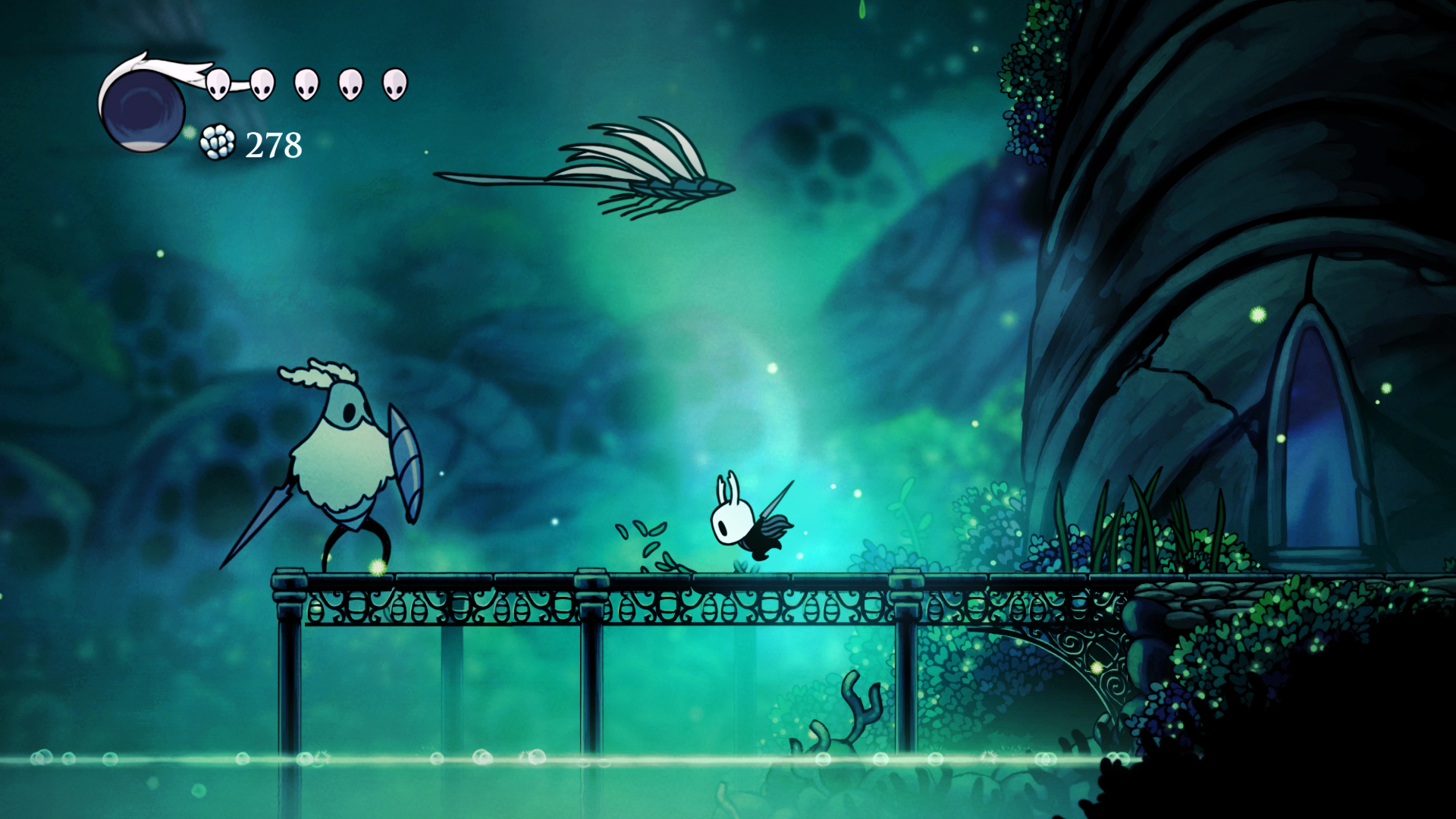
Hollow Knight's map system will frustrate players who arrive from games where maps fill in automatically. Here, each region has a hidden cartographer — Cornifer — from whom the map must be purchased. The map then shows terrain but not your current position. A separate pin item is required for that. And new areas begin pitch-dark, orientation built slowly through repeated traversal.
This is a design choice with a point. Team Cherry built a game where directional uncertainty is a feature, not a friction point to be eliminated. The best discoveries in Hollow Knight happen because a player took a wrong turn: a room they weren't supposed to find yet, a passage that bypasses a difficult sequence, an NPC whose dialogue recontextualizes a location they already left.
The visual language of each zone serves as the navigation system the minimap withholds. You know you've wandered from Greenpath into the Fungal Wastes by color, sound design, and enemy behavior before the map confirms it.
Deepnest is where this philosophy reaches its extreme. The game's most hostile region is a labyrinth of near-total darkness, deliberately incomplete mapping, fast and erratic enemies, and sound design engineered to make the player uncomfortable. It is the most effective horror sequence in any 2D platformer — achieved without a horror genre premise, purely through environment and information denial. Many players cite Deepnest as the moment Hollow Knight earned genuine respect from them.
Getting lost is part of the design. It was always supposed to feel this way.
Boss Design
Philosophy: Fair, Readable, and Worth Mastering
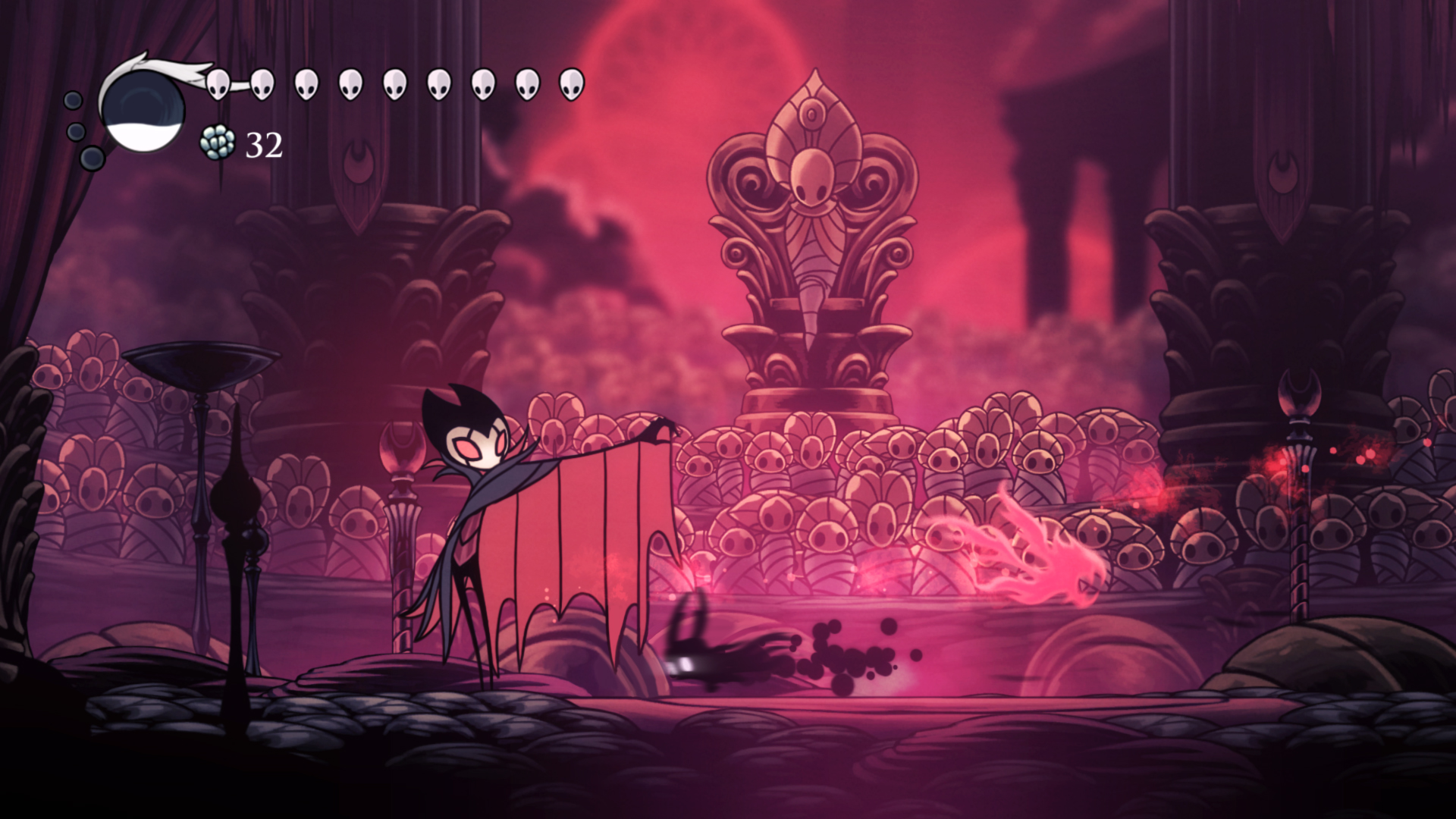
Hollow Knight's bosses are hard. Dying several times on a first encounter is not a failure state — it's the expected learning curve. What distinguishes the game's boss design is that deaths almost never feel arbitrary.
Each boss runs on readable patterns. Wind-up animations precede most attacks. Phases shift at recognizable health thresholds. Randomness is present but bounded. The post-death autopsy — that mental replay of what went wrong — almost always yields a clear answer: wrong positioning, mis-timed dodge, soul spent on offense when it should have been held for a heal.
This creates the feedback loop that makes hard games satisfying rather than punishing. Pattern recognition leads to marginal improvement leads to mastery leads to a clean clear. The gap between first attempt and zero-damage run on most Hollow Knight bosses is attributable entirely to player skill, not luck.
The Dream Bosses — encountered through Dream Nail — escalate this further. These are optional encounters against phantoms of fallen warriors, running at higher difficulty than their base counterparts. Completing them unlocks new story content and eventually changes the game's ending. They're explicitly for players who want to test their ceiling; the main game doesn't require them.
The design philosophy connecting all of this: every boss should feel like a puzzle that becomes a dance once solved. Hollow Knight's roster — from the Mantis Lords to the Broken Vessel to the Radiance — largely delivers on that promise.
Silksong: The Sequel Is Coming
Team Cherry's follow-up, Hollow Knight: Silksong, casts Hornet — a significant NPC from the first game — as the protagonist in a new kingdom called Pharloom. The combat system is faster and more aggressive than the Knight's, building on lessons from the original while creating a distinct feel. The story is independent; no prior knowledge of Hollow Knight is required to play it.
A release window has not been confirmed at the time of writing. The extended development period has generated significant fan anticipation, but Team Cherry has maintained radio silence on timing. What footage has been shown suggests the team is matching the original's ambition. The wait, by all indications, is worth it.
In the meantime: there has never been a better moment to play the first game.
Tips for New Players
Three things to prioritize when starting Hollow Knight:
Get the Mantis Claw early. This wall-jump upgrade, acquired in the Mantis Village, changes how every room in the game is traversed. Without it, movement feels restricted and many areas stay out of reach. With it, the game opens dramatically. It's accessible in the early-to-mid portion of the game — don't wait.
Check Sly's shop. The merchant Sly, found in Dirtmouth after being rescued, sells several key items that meaningfully improve quality of life in traversal and combat. As Geo (the in-game currency) accumulates, make regular visits. Some of his stock is easy to miss and makes segments later in the game noticeably harder if skipped.
Don't ignore the Dream Nail. After acquiring it, it's easy to treat the Dream Nail as a curiosity and forget to use it. Use it on sleeping enemies, on NPCs, on the ground near unusual objects. What it reveals is not decorative — it's how the game's deepest layer of story is told, and some interactions lead to content that changes the game's endgame entirely.
One more: resist the urge to look everything up. Hollow Knight is designed to reward patience and organic discovery. The community has been discussing this game for nearly a decade; the information is available when you want it. But the first time finding a hidden area through your own exploration is a specific kind of satisfaction that a walkthrough cannot replicate.
Verdict: Arguably the Best Value Game Ever Made
Hollow Knight costs $14.99. The first playthrough runs 35–45 hours. Full completion — bosses, lore, optional content — runs 60 hours or more. Three free content DLC packs were released post-launch. The price has never changed.
On pure hours-per-dollar math, Hollow Knight is competitive with any game in any genre at any price point. But the argument for it isn't efficiency — it's that the hours are good hours. The world is worth inhabiting. The combat is worth mastering. The lore is worth tracing.
Team Cherry answered questions that much larger studios had been circling for years: how do you make map exploration feel genuinely risky again? How do you build emotional resonance without cutscenes? How do you design a boss roster that's simultaneously punishing and fair?
A three-person team in Adelaide answered them — for fifteen dollars.
If you've never played Hollow Knight, start now. If you played it years ago and are remembering it favorably — the memory is accurate. If you've played every other metroidvania and somehow still haven't touched this one, you've been living in the foothills of the genre.